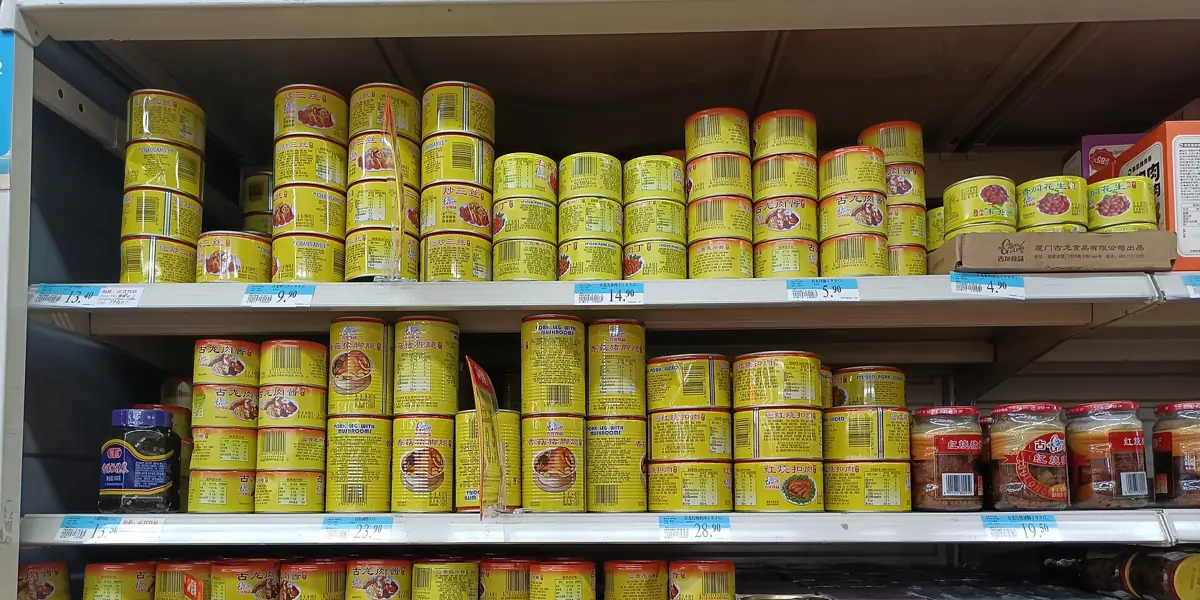

Why a food store, and why not panic buying
Supermarkets in the UK work on “just in time” deliveries. They hold little stock on site, so a sudden run on the shops, a lorry driver shortage, a cyber attack on a distribution system or roads blocked by snow can empty shelves within a day or two. Everyone who remembers 2020 knows how that feels.
The answer is not to rush out when the news breaks. That makes shortages worse for everyone, including people who cannot afford to stock up. The answer is to build a small reserve slowly, in calm times, so that when the shelves empty, you simply do not need to go.
How much food?
The Be Ready baseline is three days. Once you have that, build to a week, then two. A simple way to plan is by meals: three meals a day, for each person, for the number of days. Two adults for 14 days is 84 meals. That sounds a lot until you realise it is a few extra tins a week for a couple of months.
What to keep
Choose food that keeps for months without a fridge, that your household already eats, and that you can eat cold if you must.
| Type | Good choices | Why |
|---|---|---|
| Protein | Tinned tuna, salmon, sardines, chicken, ham, chickpeas, beans, lentils; peanut butter | Filling, and most can be eaten straight from the tin |
| Carbohydrates | Crackers, oatcakes, oats, breakfast cereal, rice, pasta, noodles, long-life bread | Energy. Crackers and cereal need no cooking |
| Fruit and veg | Tinned fruit in juice, tinned vegetables and tomatoes, dried fruit | Vitamins and fibre when fresh food runs out |
| Ready meals | Tinned soup, stew, chilli, curry; pouches of rice | Edible cold, much better warm |
| Drinks | UHT or powdered milk, long-life juice, tea, coffee | Comfort matters more than you think |
| Snacks | Nuts, cereal bars, chocolate, biscuits | Quick energy and morale |
Remember anyone with specific needs: baby milk and food, gluten-free or other special diets, and food for pets. Note that pasta and rice need water to cook, which you may be short of. Count that against your water store.
Rotate it: store what you eat, eat what you store
- Put new items at the back and use from the front. This is how shops do it, and it keeps everything in date.
- Write the date on packs in thick pen if the best-before is hard to read.
- Check twice a year, for example when the clocks change, and eat anything getting close to its date.
- Keep it cool and dry, off the floor, away from damp and sunlight. A cupboard, under a bed or under the stairs is better than a garage or loft, which get very hot and very cold.
- Dented, bulging, rusted or leaking tins should be thrown away.
When the power goes: your fridge and freezer
The Food Standards Agency’s advice (for England, Wales and Northern Ireland) for a power cut is simple: keep the doors shut.
- A fridge should stay cold for up to 4 hours.
- A full freezer should keep food frozen for up to 48 hours, or 24 hours if it is half full. These are estimates and vary by model.
- Eat food from the fridge first, then the freezer, then your cupboard store.
- In a power cut, chilled food is fine below 8°C. If the fridge reaches 8°C or above, the FSA says foods that need refrigeration, such as meat, fish, ready-to-eat foods and leftovers, should be thrown away after 4 hours unless the power comes back. A cheap fridge thermometer tells you where you stand.
- If it is cold outside (below 8°C), you can store food outdoors in a clean, sealed box, out of the sun and away from animals.
- Use food in this order: chilled food first, then defrosted frozen food, then other perishables, and your tins and dried food last.
- If you cannot boil water for infant formula, ready-to-use formula is an option. Keep some in your store if you have a baby.
A tip: keeping a few bottles of water in the freezer helps it stay cold for longer, and gives you extra drinking water as it thaws.
Cooking without power
Cold food is fine for a few days. For longer, hot food and drinks matter for morale and warmth. Options:
- A gas hob may still work in a power cut if it has no electric ignition or safety cut-off; light it with a match. Many modern hobs will not work without power.
- A camping stove on a stable surface outdoors, sheltered from wind, away from doors and windows.
- A barbecue, outdoors only, and never brought inside afterwards, even when it seems to have gone out.
- A portable power station can run a kettle or small hob for a short time, but uses its charge fast. See our power station picks.
- A vacuum flask keeps water hot for hours from a single boil.
Never use a barbecue, camping stove, patio heater or generator indoors, or in a garage, tent, porch or caravan awning. They give off carbon monoxide (CO), a poisonous gas you cannot see, smell or taste. Fit an audible CO alarm marked EN 50291 (look for the BSI Kitemark) in rooms with fuel-burning appliances.
Headache, dizziness, feeling sick, tiredness, confusion and breathlessness can be signs of CO poisoning. Get into fresh air straight away. Call 999 if someone is seriously unwell, or NHS 111 for advice. If you suspect a leak, call the gas emergency number on 0800 111 999 (0800 002 001 in Northern Ireland). NHS advice on carbon monoxide.
When shelves stay empty
If disruption lasts beyond a couple of weeks, local food banks, community groups and councils usually organise help for those who need it. Share with neighbours who are struggling: a street that pools what it has gets through far better than one where everyone hides their cupboards. Our long-haul guide to supply shortages covers this in more detail.
Kit for this guide
A rotating food store. Research-based: types of food and kit, not products we have tested.
- 3 days of no-cook food, building to 14 Research-based
- Manual tin opener Research-based
- Tinned protein: fish, meat, beans, pulses Research-based
- Long-life carbohydrates: crackers, oats, rice, pasta Research-based
- UHT milk or powdered milk Research-based
- Peanut butter, nuts, dried fruit, cereal bars Research-based
- Baby food, formula and pet food if needed Research-based
- Camping stove and fuel (outdoor use only) Research-based
Official sources we used
- Food safety in a power cut: advice for consumers (Food Standards Agency)
- Food safety in a power cut (full guidance) (Food Standards Agency, GOV.UK)
- Be ready for emergencies (Be Ready checklist) (Be Ready, UK Government)
- What to do in a power cut (British Red Cross)
- Carbon monoxide poisoning (NHS)